Elon is right about neoclouds. It just doesn't fit in a tweet.
On 25 October, Elon Musk replied "pretty much" to a post by Chamath Palihapitiya about idle AI compute in 2027, and then went further. Debt markets, he wrote, have almost entirely shut off money for any company without substantial revenue independent of AI data centers. SpaceX had just closed $40B of debt for GPUs, but it is investment grade and has Starlink and launch revenue. His conclusion: the 200+ neoclouds are headed for "guppy-level death and consolidation." Some will make it through, but not many.
Neocloud stocks dipped the next morning and recovered by the afternoon.
My first reaction was that it's a reasonable post. He has a point. But it assumes a lot of things, and most people miss them because it's compressed into a small tweet.
Quick disclosure: I'm building an AI cloud, Jarvislabs.ai. Whether that makes us a neocloud, I genuinely don't know, and that turns out to be part of the problem.
Nobody agrees what a neocloud is
There's no standard definition. Most explainers describe a neocloud as a company that rents out GPUs, networking and storage, and little else. By that description, a lot of them are bare metal providers. Some came into the data center business from outside tech because they saw how much demand there was for GPUs.
Then there's a much smaller group building across the stack and trying to become a full cloud platform. Not an AWS or a GCP, which were built around what the Fortune 500 needed, but a cloud built around AI workloads. AI infrastructure is still a green field, so I think new players have a real chance to make a difference here.
These are two different businesses. Putting every new company that raises debt to buy servers into one bucket, and pricing their risk the same way, isn't a fair assumption.
What the tweet gets right
If a company only rents out GPUs and does nothing else, a lender has good reason to be skeptical. If the way AI gets used shifts, or the GPUs sit idle, there's nothing else to pay the loan back with.
There's still a lot of debt going into GPU clouds, probably more in total than SpaceX raised. CoreWeave alone carries roughly $50 billion of debt, more than SpaceX's entire raise. Nebius's CEO has acknowledged that asset-backed financing has temporarily dried up. Borrowing is getting more expensive, and most of all for companies with little to show beyond their hardware.
Whether a GPU cloud gets through this depends on its unit economics and how much of its growth was bought with borrowed money. I'm not a finance person, so I'll leave the credit analysis to people who are. I can talk about the operating side, and that's where the tweet leaves out the most.
Why would AI demand collapse?
A common read of the tweet is that lenders are worried AI demand will collapse. I don't see that happening. AI has changed how we do our day-to-day work, but even in tech, the people using it heavily are a small share. Tech is usually the early adopter, so outside tech, adoption is lower still. There's a lot of room left.
The one scenario I can think of is an economic slowdown, where people stop paying a premium for efficiency. But in every slowdown, companies go looking for more efficient ways to work. If AI is that way, why would demand for it collapse?
The real risk is narrower, and it's the one Chamath was actually pointing at: GPUs that get bought and never used, or used at prices that don't cover the cost of the money that bought them. AI demand can keep growing and a GPU cloud can still fail if its machines sit idle while its loan payments stay fixed. That's an efficiency problem.
Selling boxes vs running a cloud
The fundamentals of running a business are the same whether you call it a cloud or a neocloud, and efficiency matters a lot. Say you have 1,000 GPUs, or 100,000. Can one customer consume all of them? Highly unlikely, unless you've signed a Microsoft or a Meta. So what matters is how many different ways customers can use what you have.
A platform gives them many: tokens from open-weight models like DeepSeek, Gemma or Nemotron, sandboxes, ways for enterprises to train or fine-tune their own models, inference endpoints. Then there's the work behind it: keeping the fleet healthy so customers always get healthy GPUs, building a brand, marketing, and a great support team. This is a very high-tech business.
Support in this business is nothing like food delivery support. The people answering tickets need to understand how physical servers are laid out, what happens when a VM breaks, what an XID error means, what to do when a GPU hits a thermal issue, how to architect a solution, and where a customer is wasting compute.
If you only hand over servers, you're assuming the customer knows how to run them. They'll have to bring Kubernetes or Slurm or something else to manage the GPUs. The alternative is building the software that handles that for them, so they can focus on their own product and their own customers.
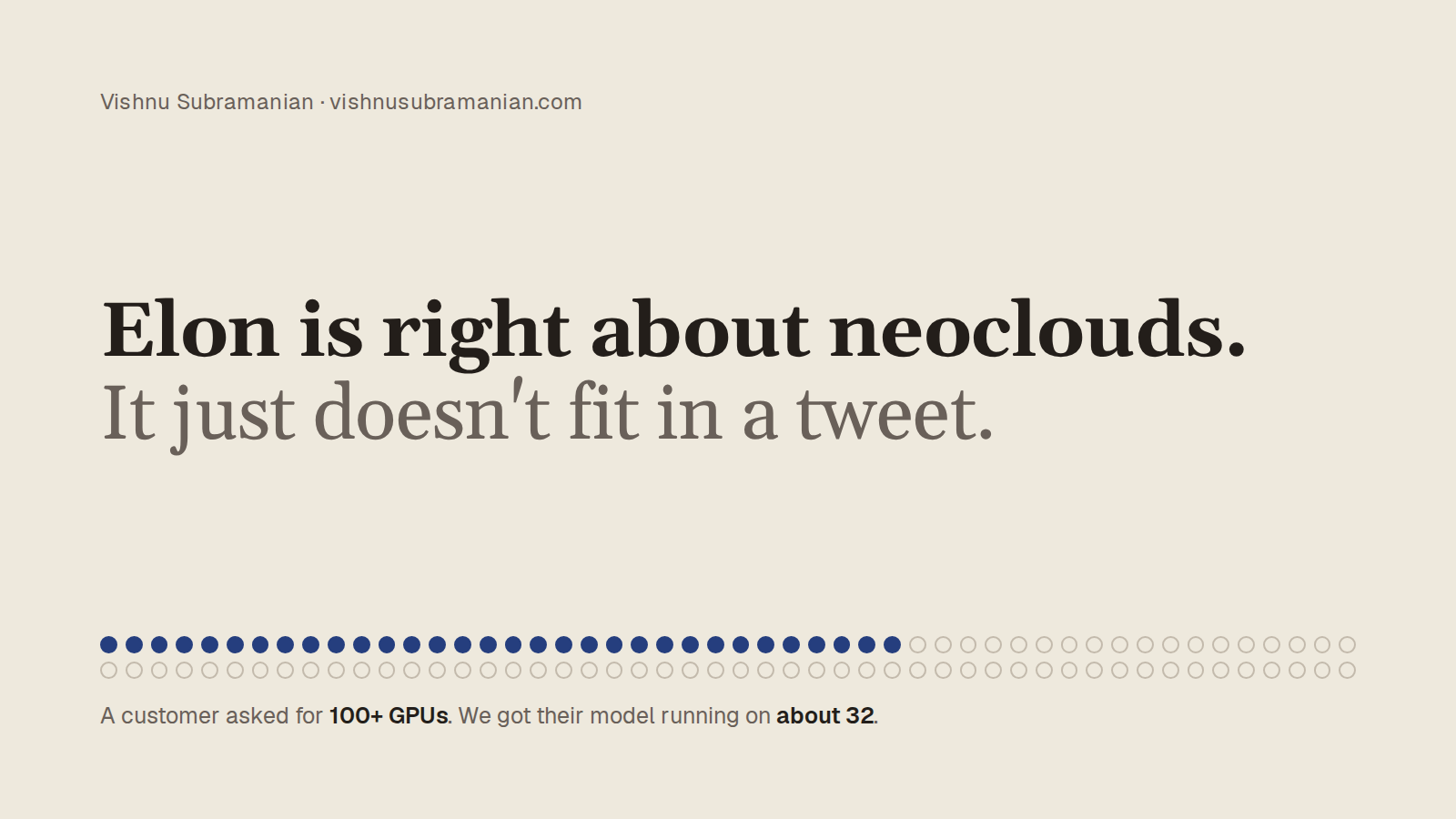
One example. A customer came to us wanting to deploy a model across 100+ GPUs. Our team helped them get it running on around 32, by picking the right kernels, the right precision and the right optimization techniques. A bare metal provider would have happily rented them all 100.
Why we helped a customer use fewer GPUs
On paper, we talked a customer out of two-thirds of what they could have spent with us. I don't see it that way.
When something gets more useful and more affordable, people use more of it. When AI coding tools came out at $20 a month, most of us weren't used to paying for subscriptions personally. Then people were ready to pay $100 and $200, because they were getting that much more out of it.
For that customer, the comparison was never 100 GPUs vs 32. It was the cost of using a frontier model for the same use case. Moving to open weights and deploying through us let them serve more of their own customers and grow profitably. When that's possible, more companies do it, and that's what we're seeing.
It's rarely all or nothing. Most teams end up hybrid: frontier models for the hard problems, open-weight models for the easy and mid-level ones. Once you make things easier, developers adopt. Harnesses like OpenCode running open-weight models like DeepSeek have made open weights much easier to use. Every company has to make its unit economics work. If AI costs more to deliver an outcome than a person would, it isn't viable, and that pressure keeps pushing work toward open weights. We see the same thing internally, and we serve open-weight models ourselves through Models, our token API.
For the GPU clouds doing this, demand is growing, which is why prices are rising in the short term. Over a longer window, prices tell a different story. In 2017, AWS launched the V100 at $3.06 an hour and kept it around there for years. An H100 on a GPU cloud today sits in roughly the same hourly range, and what you get for that hour is several generations ahead. Without the new generation of GPU clouds, running AI on today's hardware would cost a lot more than it does.
We've seen this before
Imagine most GPU clouds disappear in five years and we're left with three or four hyperscalers. Compute ends up available to a small set of companies and people. That's a world we definitely don't want.
The CPU cloud never worked that way. Alongside the hyperscalers there were DigitalOcean, OVHcloud, Vultr and others, plus data centers all over the world. There was a shakeout there too: plenty of hosting companies that didn't run efficiently shut down or got absorbed. But a healthy tier of independents survived below the giants.
GPUs need more capital than CPUs did. But CPU data centers were already far more capital-intensive than most software businesses, and the pattern held. I'd expect it to hold again: consolidation, and a set of independent clouds that come out the other side stronger. That's a more useful way to think about this than arguing over who counts as a neocloud.
What the survivors will look like
A business is a collection of choices. Xerox's research lab had the mouse and the graphical interface, the ingredients of a great product, and others built the businesses around them. Why didn't Xerox win? A great company is a combination of many things.
A cloud is a platform, and a platform is many products. Inference wasn't a big business two years ago. Sandboxes weren't either. Nobody knows what the next one will be. The clouds that keep building those layers, with good marketing, architects who help customers win, and sales and operations that run efficiently, have the right to win. The inefficient ones don't, and the debt market is just making that happen faster.
Survival also depends on the timescale you look at. The companies that figure these things out will flourish and keep growing.
So Elon is right. It just doesn't fit in a tweet. The GPU clouds that disappear will mostly be the ones that sold boxes. The ones that built clouds have a real shot at being around, and growing, long after this cycle.

